
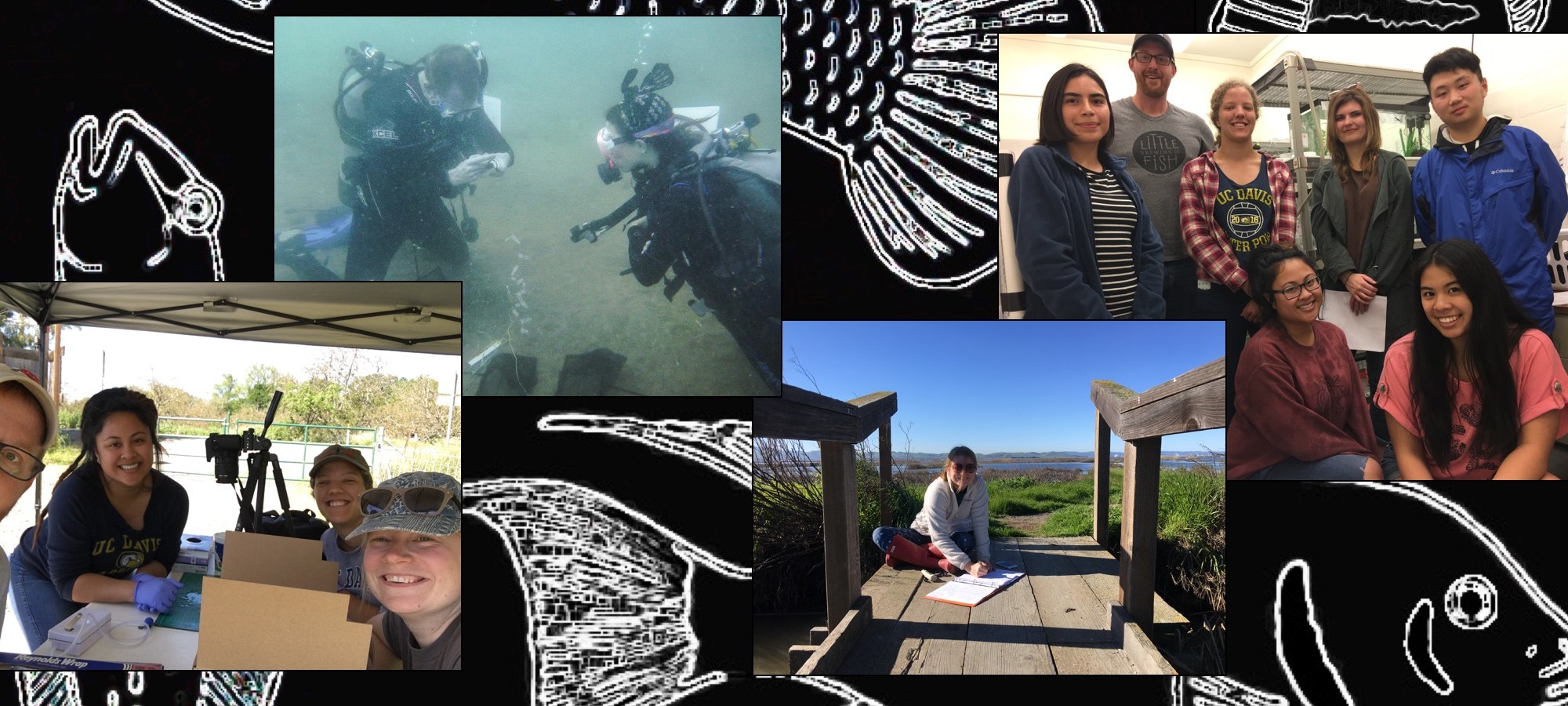
Globally, wildlife face unprecedented environmental changes as a result of human activity. We are gaining insights into the consequences of these environmental changes, and whether and how organisms are responding to them. Despite these advances, there is a dearth of information regarding the potential interactive effects of specific environmental changes. A major focus of work in our lab is investigating these interactive effects to better understand how organisms respond to a rapidly changing world.
Through ongoing research on native and introduced Gambusia fishes (mosquitofish) in the mid-Atlantic region, we are investigating the impacts of chemical pollution on physiology, morphology, and behavior. With this information we aim to understand the potential for chemical pollution to facilitate or moderate range expansion of introduced (G. affinis) and native (G. holbrooki) mosquitofish in the region.
Amphibians are unique amongst vertebrates in that their larval and adult stages span aquatic and terrestrial environments. Thus, human impacts that influence amphibians may facilitate cascading effects of environmental changes in aquatic systems into terrestrial systems (and vice versa). We are studying the impacts of chemical pollutants on several species of amphibians to understand how exposure to environmentally relevant concentrations of chemical pollutants during the aquatic larval stage influences adult (terrestrial) morphology, physiology, and behavior. A major focus of this work involves understanding how larval exposure influences adult resilience to climate change (increased temperature and changing precipitation patterns).
My dissertation work focused on how individual and dyadic behaviors influenced and was influenced by other group members. This work was performed using the cichlid fish Neolamprologus pulcher in lab-based studies and naturally-formed groups. I remain interested in examining social group dynamics in light of environmental variation and perturbations in both Tanganyikan cichlids as well as Stegastes damselfish in the Caribbean.
AWARDS, GRANTS, AND FELLOWSHIPS:
Faculty Grants Committee (MU, 2020-2024) – $8,347
PASSHE Faculty Professional Development Council Grant (2023) – $5000
PASSHE Faculty Professional Development Council Grant (2021) – $8000
NSF Postdoctoral Research Fellowship in Biology (NSF, 2016) – $138,000
Alumni Grants for Graduate Research and Scholarship (OSU, 2014) – $1960
Ray Travel Award (OSU, 2013) – $750
Fish Systematics Endowment Award (OSU, 2013) – $1000
SciFund Challenge (SciFund, 2012) – $1000
 The Ligocki Research Group